


EXPERIMENTAL, GENERATIVE, AND COLLABORATIVE: IMPACT IS A VERB AT FADA GALLERY
- by David Mann
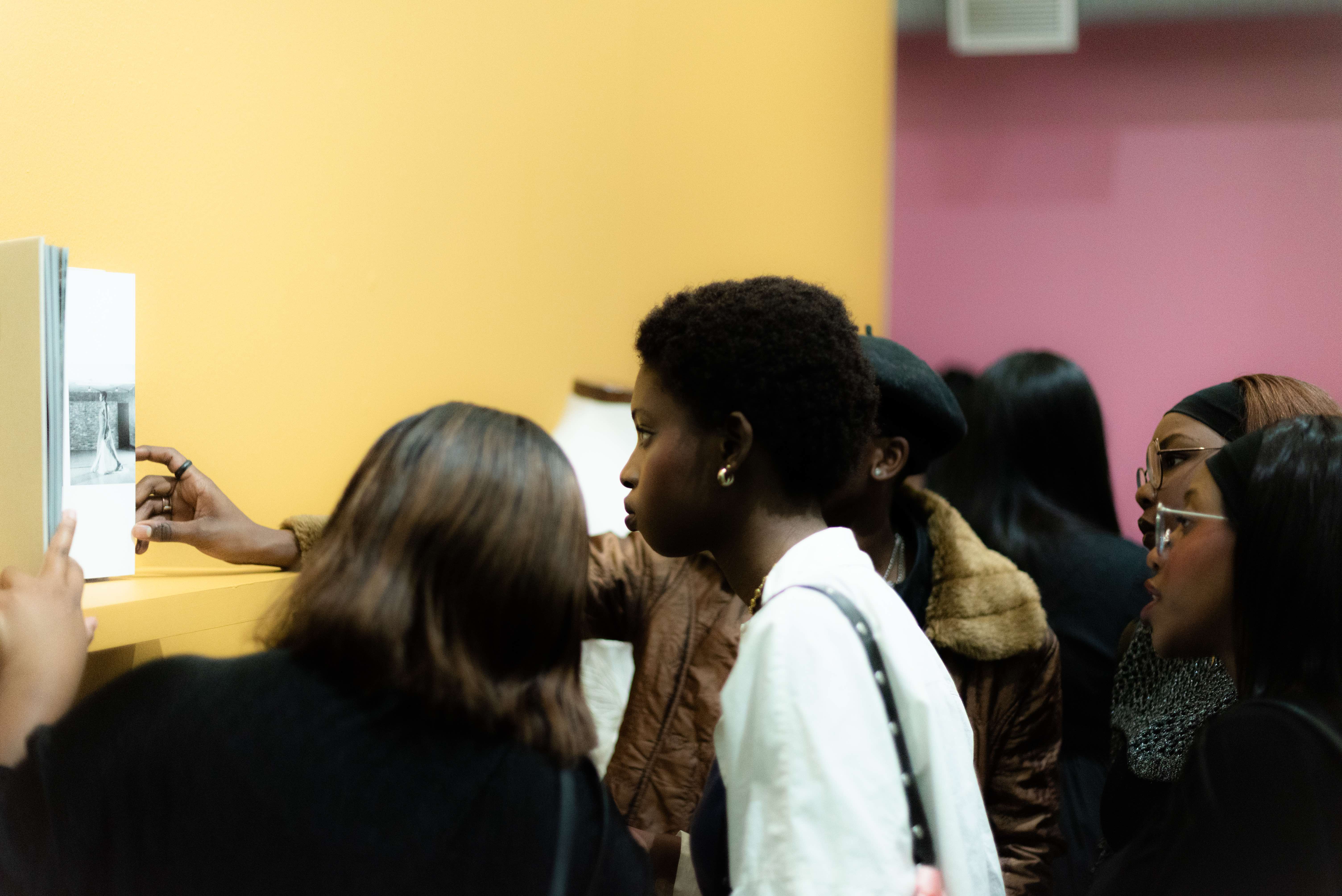 IMPACT is a verb exhibition, image credit: UJ Arts & Culture
--------------------
It should be in the interest of any good institution to consistently question itself and its ways of working. In the case of the University of Johannesburg’s Faculty of Art, Design and Architecture (FADA), the question it’s asking itself is this: What kind of impact does our work have – on us, our students, our faculty, and the world around us?
IMPACT is a verb, a creative research exhibition curated by FADA’s Dr Farieda Nazier, is something of a collective attempt by FADA academics, associates, and artists in residence, at responding to this question. Featuring 14 practitioners from the fields of architecture, visual art, art therapy, fashion, graphics, industrial design, microbiology and multimedia, the group exhibition occupies both floors of the FADA gallery – its conventional white cube above and its darkened, den-like space below – with each artwork, installation, or intervention serving as a response.

A precarious pile of brightly coloured bricks is what you see first. It’s Alexander Opper’s SPECTRUM 1, a sculpture of glazed clay bricks situated atop a wooden plant stand and a thin sheet of steel. The sculpture is a prismatic division of colour, each brick with its own radiant glaze, collectively forming a vertical rainbow. To the left, hung in a neat row where the wall meets the ceiling, is SPECTRUM 2, a series of seven canvases, each one with a methodical rainbow inside of it, and collectively tracing a slow, precise arc of light. Opper comes from an architectural background and is a prolific visual artist. His work is oftentimes an intersection of the two fields – at once poetic and pragmatic, the outcome of sentiment and schematics alike. With the SPECTRUM works, Opper seems interested in the multiple readings of these material rainbows.
Certainly, we bring our own politics, temperaments, experiences, and ways of seeing to a work. When I first see SPECTRUM 1 and 2, I assume it’s a work about the fluidity of identity – sexual, physical, political and otherwise. Viewing it a second time, however – and after too much talk radio in the car – global politics plague my mind, and the works read differently. Now, that precise shift of colour from left to right on the canvases feels like a comment on the inevitable pull away from nuance and empathy towards bigotry and idiocy. I see an echo of this in the sculpture, too – a bright, beautiful monument to complexity and diversity teetering on the verge of collapse. But I linger a while, and other possibilities emerge. There’s a temporal element to the canvases that’s quite meditative, and even the shadows cast by the sculpture veer off in two distinct directions – two different possibilities. Zadie Smith comes to mind: “The world does not deliver meaning to you, you have to make it meaningful… That’s the deal: you have to live. You cannot live by slogans, dead ideas, cliches, or national flags.”
 Alexander Opper, SPECTRUM 1 and 2, image credit: UJ Arts & Culture
On the opposite wall sits Ruth Sacks’ work Pretend Sculpture. “Pretend it’s a place of learning.” The words, shaped out of meranti wood and perched on three rows of shelves, read both as an instruction and a sardonic reflection on the function of the university classroom. The letters, which have a playful three-dimensionality to them, look like bookends. Noticeably, there is not a single book on the shelves. What are we left with, then? A short-circuiting pedagogy, a languishing logic? As if echoing this, the ‘G’, the final letter in the line-up, inches towards the edge of the shelf, eager to leap towards freedom or plunge into finality. Text-based works, perhaps more so than other mediums, have the brilliant potential to sneak levity, meaning, and enduring provocations into public and private spaces alike. Sacks’ Pretend Sculpture is sublime, its sentiment echoing throughout the exhibition and outside of the gallery space as well.
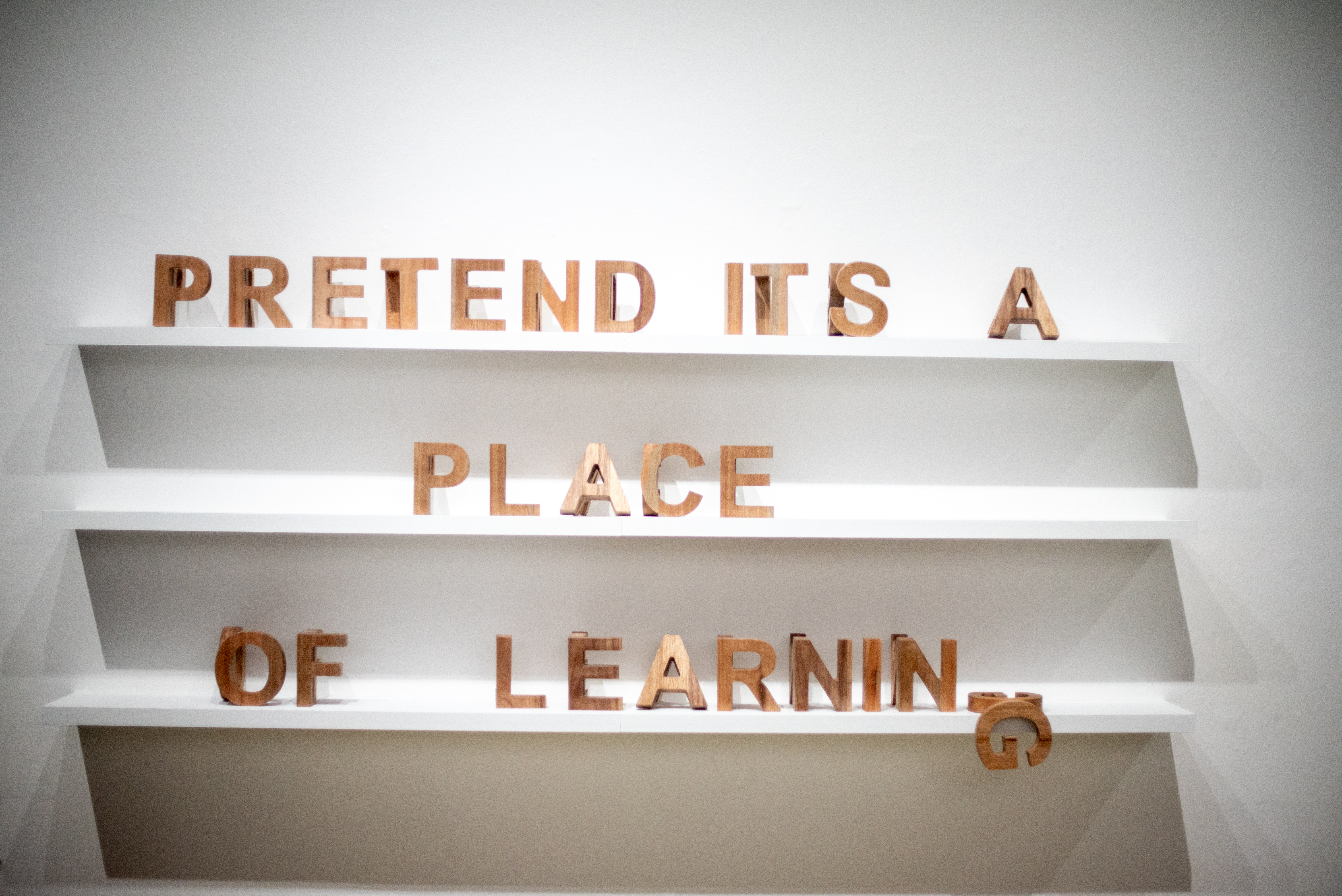 Ruth Sacks, Pretend Sculpture, image credit: UJ Arts & Culture
A plaintive bell rings throughout the space. It’s from the lone video work in the exhibition, Oupa Sibeko’s Lost Cow (2023-ongoing). The footage is recognisable, extracted from a longer film made during his Schloss Solitude residency. In this iteration, we see Sibeko barely clothed and wandering around in the snow and fog, ringing a cowbell. In the tight loop of the film, which could have been a touch longer, his performance becomes a vignette, a refrain, an Instagram reel on repeat. Sibeko is in total isolation, a South African artist cutting a sharp silhouette in the snowy landscape of Northern Europe, with only the tinny jangle of a cowbell sounding out around him. In addition to his painterly practice, Sibeko’s known for his playful and public acts of performance. Most recently, he was in the FADA gallery, coating himself in honey and feathers for a collaborative performance with Lerato Matolodi. Lost Cow (2023-ongoing) is a far more sombre work, best viewed as an ongoing experiment towards the artist’s broader interests in place, identity, and belonging.
Around the corner is Neil Badenhorst’s everything is embarrassing. Coming from the design side of things, Badenhorst showcases his illustrations in the form of small zines, handmade art books, and objects – the contents of which are mirrored in prints and murals in the space. The result is a fragmented collection of work: part mural, part studio scene, part sketchbook explosion, putting forward ideas around self-fashioning, self-mythologising, and documenting, that centres provisionality and process. It’s an inviting and collectively intimate body of work, but the space lets it down, somewhat. Should it have been situated in a corner of the upstairs space with some tighter curation, or perhaps sectioned off with a pre-fab wall to better replicate a studio atmosphere, it would be all the more engaging.
 Neil Badenhorst, everything is embarrassing, image credit: UJ Arts & Culture
Kate Shand’s litany of broken ceramics, Picking up the pieces, stands out at first like a small tragedy. Shards of ceramics are scattered on the floor and on plinths, fired, cracked, marked, burnished, and scattered, their forms like roadmaps for their own history, making, and breaking. Shand works with art therapy, and her interest here is in the visible impact of loss. Amongst these abstract, reconfigured forms are found objects — bottlecaps, cutlery, name tags. On the walls of the space, impressions of these objects show up in works of plain clay. If the shattered ceramic objects are the roadmaps of process and loss, these unglazed impressions are like legends or keys, helping us to better read the scene. Most of the work sits on a low rectangular plinth, and in this sea of shards, some of the impact is lost. It is in the smaller moments – the wall-based works and individual plinths bearing single ceramic works – that Shand’s dialogue with grief is felt most keenly.
 Kate Shand, Picking up the pieces, image credit: UJ Arts & Culture
Two bodies of work come from Fashion Design, namely the Martin Molefe Memory Project by Khaya Mchunu and Kiara Gounder, and Xinhlamune by Tinyiko Baloyi. Mchunu and Gounder’s project is an ode to the Soweto-based fashion designer, Molefe. It’s a rich and multifaceted project that needs an exhibition of its own, but the two use the space they’re given by filling it with speculative garments inspired by Molefe’s designs, as well as a research zine, and a photo book featuring images of the garments being modelled. Baloyi’s work brings indigenous design principles to the fore, referencing the techniques used in the making of Tsonga n’wana figures. The result is a series of bright, knotted, folded and wrapped garments that function as archives of design knowledge as well as standalone items. I only wish that they benefited from the space and light of the upper floor, instead of being tucked away downstairs.
Other works are smaller in scale, but succinctly executed. Tobias Barnard’s Let it Rain is a collection of epoxy resin droplets filled with E. coli bacteria. Suspended above the staircase leading downstairs, they put forward a simple provocation around the beauty and joy of rain, and the crisis of water access, sanitation, and hygiene in the country. Neil Lowe’s installation features projections, sculptures, and sound to look at the idea of colonial ruin and legacy. In the darkened lower floor, they do appear as spectres, although, contending with the rest of the works in the space, their hauntings are not always clear. Katlego Madumo’s installation works a little too well. The adaptive desk concept is inspired by gallery and museum plinths, and disappears almost seamlessly into the FADA gallery, save for its tongue-in-cheek branding – The White Cube. I walked past it twice before realising it’s a part of the show.
 Tobias Barnard, Let it Rain, image credit: UJ Arts & Culture
Alison Kearney’s collaborative project with Cameron Harris and Gavin Wayte is a sprawling installation. Titled Conflunce, the work is a network of drawings on tracing paper, installed to flow like the Jukskei and Tame rivers, branching off in different riverines and tributaries. An accompanying sound installation blends field recordings from both rivers with electronically transformed sounds from Kearney’s drawing process. The work centres these two famously polluted rivers in different parts of the world, but it also reflects on the interconnectedness of things – people, nature, the choices we make and the impact they have on the world around us. On the opening night, Kearney and her collaborators staged a live performance, seeing the drawing and the sound spill out of the FADA gallery and into the campus amphitheatre, inviting the audience to participate by leaving a mark, or simply bearing witness to the work.
 Alison Kearney’s collaborative project with Cameron Harris and Gavin Wayte, installation, Conflunce, image credit: UJ Arts & Culture
How does all of this fit into the space? What is its impact? Importantly, the inclusion of works from the specialisations of visual art, design, fashion, and architecture in a gallery space that usually houses works of visual art exclusively, is a simple, but essential act. It reframes the gallery as a lab – a place for interdisciplinary experimentation, discovery and failure. It also frames our engagement with the works, differently. They are here to be made sense of as creative research, rather than appreciated for their commercial or aesthetic value alone. And impact is always relational, as Nazier reminds us. Seemingly disparate artworks and disciplines sit alongside each other, brush up against or clash with one another, and spark new associations and ideas. Walkabouts and public activations remind us that art should be in the world – that we should carry its meaning and conversation with us.
In Johannesburg, a city whose art scene has become overwhelmingly commercial in the last few years, exhibitions like this are essential reminders of the role of galleries and artistic institutions in creating programming that is experimental, generative, and collaborative.
10 Oct 2025


