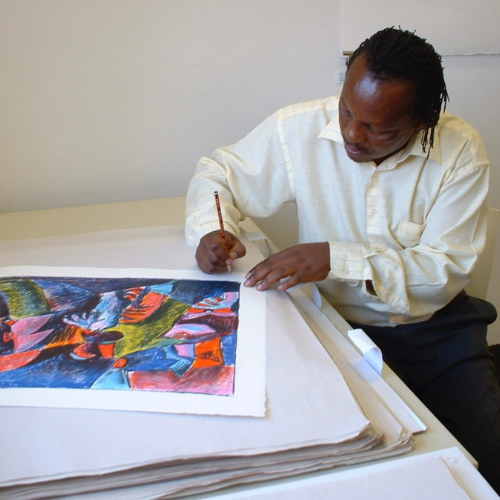
Tony Nkotsi (b. 1955) is a highly respected South African artist whose life and work are deeply entwined with the country’s history of struggle and artistic resistance. Born in Johannesburg’s Western Township, his early passion for art was shaped by informal classes in Soweto and a profound admiration for artists like Dumile Feni. His involvement in the 1976 student uprisings and subsequent detention was a pivotal experience, cementing his belief in art as a vehicle for social and political expression.
This path led him to the legendary Rorkes Drift Art Centre, where he studied from 1980 until its closure in 1982. At Rorke's Drift, Nkotsi was immersed in the world of printmaking, or "democratic multiples," a medium that resonated with his political sentiments. The Centre’s extensive curriculum—covering intaglio, woodcuts, and screenprinting—provided him with a technical mastery that remains a hallmark of his practice. This period solidified his commitment to socially conscious work, exemplified by early pieces like his 1982 Portrait of a Man (Biko).
A dedicated community builder, Nkotsi played an instrumental role in developing Johannesburg's art infrastructure. Alongside his lifelong friend Dumisani Mabaso, he helped establish the Squzu Studio for printmaking and assisted with the Hammanskraal Art Project. He became a key educator, teaching printmaking at institutions like the Federated Union of Black Artists (FUBA), the Open School, and the Johannesburg Art Foundation.
Over the years, Nkotsi’s visual language evolved to embrace abstract expressionist forms, while retaining its political undertones. His significant contributions have been recognized both locally and internationally. In 1988, he was awarded a British Council scholarship to work in Scotland, and he held a solo exhibition at the prestigious Goodman Gallery in 1987, alongside participating in numerous group shows worldwide.
×
Tony Nkotsi (b. 1955) is a highly respected South African artist whose life and work are deeply entwined with the country’s history of struggle and artistic resistance. Born in Johannesburg’s Western Township, his early passion for art was shaped by informal classes in Soweto and a profound admiration for artists like Dumile Feni. His involvement in the 1976 student uprisings and subsequent detention was a pivotal experience, cementing his belief in art as a vehicle for social and political expression.
This path led him to the legendary Rorkes Drift Art Centre, where he studied from 1980 until its closure in 1982. At Rorke's Drift, Nkotsi was immersed in the world of printmaking, or "democratic multiples," a medium that resonated with his political sentiments. The Centre’s extensive curriculum—covering intaglio, woodcuts, and screenprinting—provided him with a technical mastery that remains a hallmark of his practice. This period solidified his commitment to socially conscious work, exemplified by early pieces like his 1982 Portrait of a Man (Biko).
A dedicated community builder, Nkotsi played an instrumental role in developing Johannesburg's art infrastructure. Alongside his lifelong friend Dumisani Mabaso, he helped establish the Squzu Studio for printmaking and assisted with the Hammanskraal Art Project. He became a key educator, teaching printmaking at institutions like the Federated Union of Black Artists (FUBA), the Open School, and the Johannesburg Art Foundation.
Over the years, Nkotsi’s visual language evolved to embrace abstract expressionist forms, while retaining its political undertones. His significant contributions have been recognized both locally and internationally. In 1988, he was awarded a British Council scholarship to work in Scotland, and he held a solo exhibition at the prestigious Goodman Gallery in 1987, alongside participating in numerous group shows worldwide.
Read More
We can't find products matching the selection.
There are currently no artworks by this artist available on Latitudes.
Please contact
info@latitudes.online
if you would like us to source works.