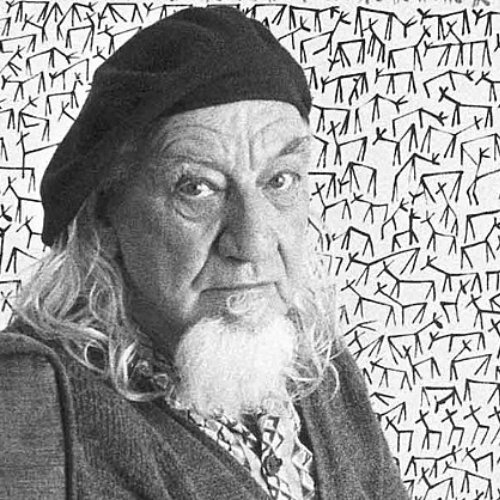
Walter Battiss (1906-1982) was one of South Africa's most significant and innovative modern artists, known for his lifelong dedication to art education and his dynamic evolution of style. A founding member of the New Group, Battiss was a revered art educator for over 30 years. His early realistic painting style transformed following travels in Europe and pivotal meetings with figures like Abbé Henri Breuil, Pablo Picasso, and Gino Severini, leading to a more symbolic and hieratic approach.
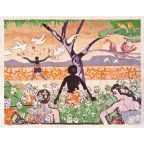
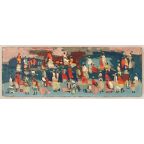
Throughout his career, Battiss seamlessly absorbed and reinterpreted a wide range of influences. His work saw the introduction of calligraphic forms, the abstract influence of Ndebele bead work, experiments with coloured woodcuts, and later, the use of palette-knife techniques with graffito. His extensive travels to the Middle East and Greece further expanded his visual language, introducing Pre-Islamic and island-inspired motifs into his creative thinking.
A pioneer in South African printmaking, Battiss championed the medium of serigraphy (silkscreen), culminating in his organisation of the country's first exhibition of serigraphs in 1970. His immense contribution to South African art is immortalized in the Walter Battiss Museum in his hometown of Somerset East. His work continues to be celebrated for its intellectual curiosity, vibrant energy, and unique synthesis of global and local influences.
×
Walter Battiss (1906-1982) was one of South Africa's most significant and innovative modern artists, known for his lifelong dedication to art education and his dynamic evolution of style. A founding member of the New Group, Battiss was a revered art educator for over 30 years. His early realistic painting style transformed following travels in Europe and pivotal meetings with figures like Abbé Henri Breuil, Pablo Picasso, and Gino Severini, leading to a more symbolic and hieratic approach.
Throughout his career, Battiss seamlessly absorbed and reinterpreted a wide range of influences. His work saw the introduction of calligraphic forms, the abstract influence of Ndebele bead work, experiments with coloured woodcuts, and later, the use of palette-knife techniques with graffito. His extensive travels to the Middle East and Greece further expanded his visual language, introducing Pre-Islamic and island-inspired motifs into his creative thinking.
A pioneer in South African printmaking, Battiss championed the medium of serigraphy (silkscreen), culminating in his organisation of the country's first exhibition of serigraphs in 1970. His immense contribution to South African art is immortalized in the Walter Battiss Museum in his hometown of Somerset East. His work continues to be celebrated for its intellectual curiosity, vibrant energy, and unique synthesis of global and local influences.