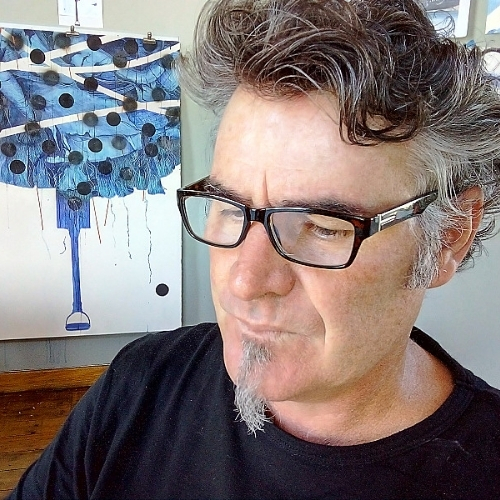
Wessel van Huyssteen is a full-time practising artist based in the Free State, holding multiple degrees including a Master of Arts in Fine Arts with distinction from Wits University (2017). His artistic practice is a deep investigation into the landscape and the complex ways humans impact our perception and reading of place.
Central to his work is the concept of "diaphanous barriers"—translucent veils like the frost cloths covering fruit trees, safety fences at construction sites, or coverings on buildings under restoration. For van Huyssteen, these grids or coverings are conceptually rich, speaking to the dualities of protection and peril. They visually alter the shape of what they conceal, prompting an intuitive and rational inquiry into the marks left upon a location.
Influenced by Peter Wohlleben's book, The Hidden Life of Trees, van Huyssteen's art laments the destruction of natural ecosystems and their "memories." He creates a powerful dialogue by contrasting what he terms the "irrational order of a fascist state," representing destructive neo-liberal policies, with the "rational chaos of conservation." Through this lens, his work becomes a literal and metaphorical exploration of the conflict between human control and the resilience of nature.
×
Wessel van Huyssteen is a full-time practising artist based in the Free State, holding multiple degrees including a Master of Arts in Fine Arts with distinction from Wits University (2017). His artistic practice is a deep investigation into the landscape and the complex ways humans impact our perception and reading of place.
Central to his work is the concept of "diaphanous barriers"—translucent veils like the frost cloths covering fruit trees, safety fences at construction sites, or coverings on buildings under restoration. For van Huyssteen, these grids or coverings are conceptually rich, speaking to the dualities of protection and peril. They visually alter the shape of what they conceal, prompting an intuitive and rational inquiry into the marks left upon a location.
Influenced by Peter Wohlleben's book, The Hidden Life of Trees, van Huyssteen's art laments the destruction of natural ecosystems and their "memories." He creates a powerful dialogue by contrasting what he terms the "irrational order of a fascist state," representing destructive neo-liberal policies, with the "rational chaos of conservation." Through this lens, his work becomes a literal and metaphorical exploration of the conflict between human control and the resilience of nature.