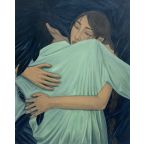



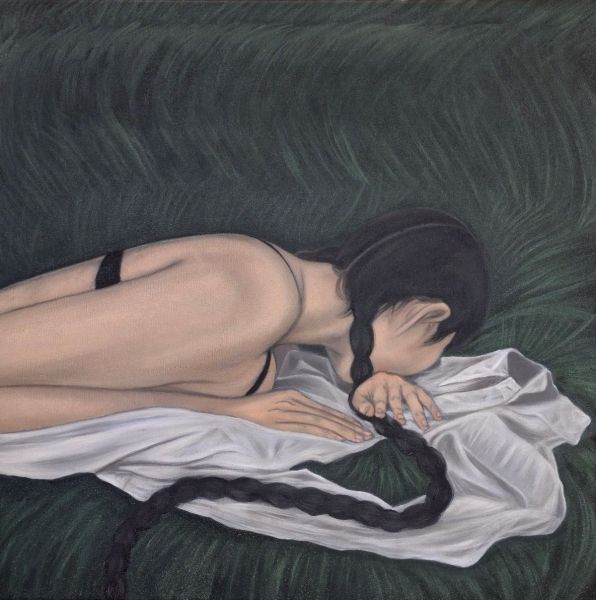


When can I say your name
Store Review (0)PRESENTED BY : Origin Art
| Medium | Oil on canvas |
|---|---|
| Location | Johannesburg, South Africa |
| Height | 76.20 cm |
| Width | 76.20 cm |
| Artist | Mira Jaan |
| Year | 2025 |
Memory, because we remember primarily through images, and we believe what we remember (sometimes to our detriment); sight, because 'seeing is believing'; and love, because believing grows from the same root as loving.
Daniel Levi Strauss, Photography and Belief, 2020
When looking at what a myth was to me I identified it as a memory abstracted. With pieces forgotten and then filled in over time into a story we carry with us. retold over and over again and thus changed with time.
What details were originally left behind, what stories were created from the gaps?
I considered this to be a big part of my theme and decided as well to loosely look at the Greek myth of Apollo and Hyacinthus, a tragic tale of love and loss. Apollo, the god of the sun, fell in love with Hyacinthus, a beautiful Spartan prince. Their time together was cut short when Hyacinthus was struck and killed by a discus—either through Apollo’s accidental throw or the interference of a jealous Zephyrus, the god of the west wind. Devastated by his death, Apollo caused a flower to grow from Hyacinthus’s blood, naming it the hyacinth.
In the first portrait, I portray a girl in longing, laying down on a shirt from a loved one not pictured and likely lost. Her gaze is turned from the viewer, looking towards a dark field of grass. The density and darkness of the grass act as a metaphor for memory, looking to find something of an image only to be met with the darkness of its erasure, the green weaves interlacing the fractions of its existence and the feelings it has left behind.
In the second still life, the vase of flowers replaces her grieving body. Like Hyacinthus's blood transformed into the flower of his namesake, there is something left behind always. The shirt from his body and the lily flowers are an impression of how he felt to the grieving girl. His likeness subject to myth, as we are left to look for him in the fragments he has left behind and create our own story from it.
These pieces aim to tell a story of love, loss, longing, memory, and transformation, honing in on the fragments left behind, to, as myth would allow, be filled in with an impression over time.
 Download PDF