


ReCurate | I've Found My Roots
ReCurate presents I've Found My Roots
'I’ve Found My Roots", a first-time collaborative project between Diablo Santana and Moratiwa Molema, is an intimate, photographic journey that leads us to examine themes of home, identity, and belonging to a place beyond the perceived notions of nationhood.
While interrogating these themes through a literal “return to the elements that have sustained them - water, soil, rocks, and plant life…(and) the (waters of a) Dam that has quietly nourished them for most of their lives” (extracted from Santana & Molema’s Artists’ Statement), the artists moved beyond the process of documenting the surroundings and their interactions with them, to immersing themselves into an alchemical narrative of how natural and metaphysical elements can shape our sense of personhood, being, and belonging in nuanced ways and meanings.
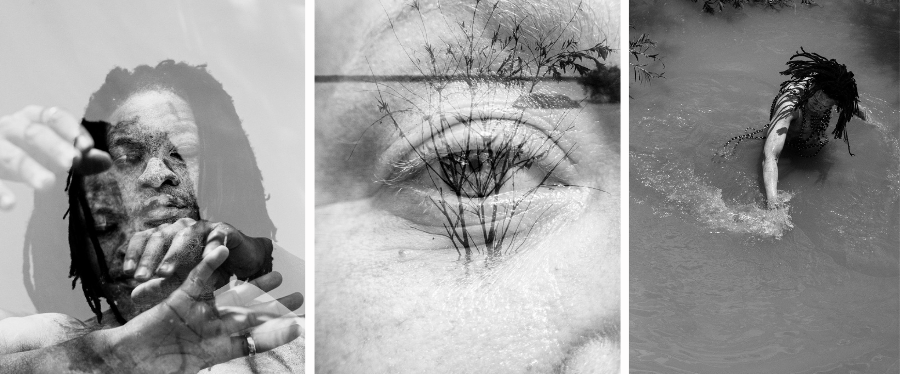
The works present an unfolding of layered, sensorial encounters with the land surrounding the Gaborone Dam and its waters through photo montage. The artists collapse distinctions between body and environment, producing morphed images that feel simultaneously constructed and organic. Surfaces and textures fold into one another: skin becomes bark, roots traverse torsos and intertwine with hair, and water dissolves edges. The result is a visual language where form is not fixed but always in the process of becoming, suggesting a profound oneness between human and earth and a textural depth that mirrors the layered histories of the Dam itself. This is further heightened by the artists’ deliberate use of a monochromatic, mostly grey-toned palette, which accentuates the dream-like, metamorphic quality of the layered forms and textures.
Central to the exhibition is a tension between voyeurism and intimacy. The close-up framing draws the viewer into private, almost tactile proximity with both human and non-human subjects. In some of the images, a partially obscured figure is intertwined with tree trunks and roots, or we see faces hidden or fragmented, resisting full visibility. This withholding complicates the act of looking: we are invited to witness, yet denied complete access – allowing the artists an almost sacred ritualistic process of becoming one with their environment in a manner that is all at once veiled and also expository. The viewer becomes acutely aware of their position as observer, navigating a space where intimacy borders on intrusion.
A striking sense of exposure and vulnerability grows as we are given, again, semi-voyeuristic views of the human form, sometimes appearing isolated, often naked or stripped of contextual markers, merging with the landscape in ways that are both protective and unsettling. This vulnerability extends beyond the body to the environment itself. Close-up images of roots, bark, and earth carry a similar sense of bareness—revealing inner structures typically concealed beneath the surface. In this way, the land is not merely a backdrop but a subject that is equally exposed, bearing its own histories of nourishment, drought, and renewal.
Surrealism permeates the exhibition, not as fantastical departures from reality, but as a means of accessing deeper truths. The improbable merging of bodies and natural forms disrupts conventional ways of seeing, allowing the works to operate in a liminal space between the real and the imagined. These surreal gestures echo the artists’ engagement with the Gaborone Dam as a site where absence and abundance coexist—where memory, history, and present experience are layered and inseparable. So, too, this becomes the metaphorical examination of the emergence of self from the inseparable layering of memory, history, and lived experience.
Ultimately, the exhibition offers a questioning and a reimagining of home and belonging. Home is not a place to be located, but a condition of being—felt in the textures of earth, the flow of water, and the quiet persistence of roots that bind all life together.
This show runs from 27 March 2026 to 30 April 2026
Read More