


EBONY/CURATED | As Necessary as Bread

EBONY/CURATED Presents As Necessary as Bread
EBONY/CURATED present's As Necessary as Bread, the debut solo exhibition by contemporary photographer Gabrielle Kannemeyer.
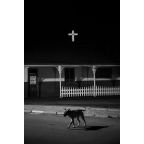
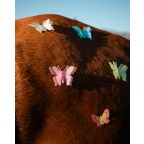
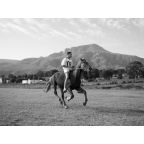
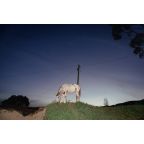
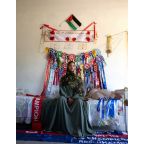
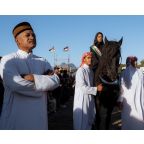
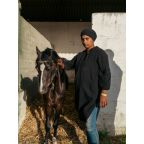
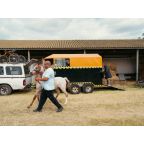
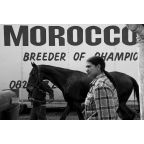
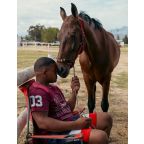
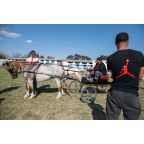
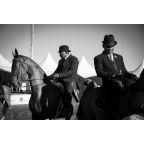
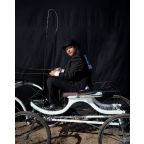
Rooted in years of immersion, Kannemeyer documents the horse cultures of her community in the Western Cape, and specifically the Cape Town and Overberg regions. Horses, long central to South Africa's history of conquest, labour, and resistance, become in her photographs both subject and signifier, at once reminders of colonial machinery and creatures of pride, joy, and cultural inheritance.
The work's title is borrowed from historian Sandra Swart's book, which details the complex history of the horse in South Africa, an animal that arrived with the first colonial ships. Swart cites Dutch coloniser Jan van Riebeeck, who, upon arriving in the Cape, requested horses from Amsterdam, claiming they were as necessary as bread. For van Riebeeck, horses were infrastructure: essential to conquest, land seizure, and economic extraction. Yet in Kannemeyer's photographs, produced within her community, the horse is repositioned. No longer merely a tool of domination, the animal becomes a collaborator in reimagining and reimaging heritage, belonging, and sovereignty.
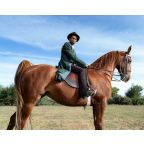
In one striking portrait, a young woman sits astride a chestnut horse, her yellow abaya and hijab cascading over the animal's muscular flank. The composition echoes the tradition of equestrian portraiture once reserved for monarchs and generals – big men of big power. The image honours a young woman of colour as a figure of sovereignty in her own right, with the horse amplifying her presence rather than serving as a backdrop for authority.
For Kannemeyer, who was introduced to horses through her father, these images are deeply personal. They form part of what she calls a living archive, a counter-archive that unsettles dominant class-coded equestrian iconographies that have long been romanticised. "The horse," she writes, "was central to making South African society, both materially and imaginatively. It is an emblem of colonial power, a marker of class stratification, but also a locus of resistance, pride and belonging for communities historically excluded from dominant equestrian narratives."
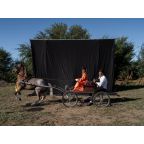
In As Necessary as Bread, the horse, the rider or driver, the photographer, and the camera converge as collaborators. The images resist flattening into a single meaning: they hold open the tension between colonial history and contemporary reclamation, between domination and joy. What emerges is not ethnography, but an embodied negotiation of heritage, belonging, and visibility.
Gabrielle Kannemeyer's work reminds us that leisure, spectacle, and tradition are not neutral privileges but contested terrains. Her photographs insist on recognition, on dignity, and on the right of historically marginalised communities to both make and enjoy culture. As Frederick Douglass once observed, the lives of the enslaved and of animals were bound together by their shared positioning as property; both denied full personhood, both subjected to use, exchange, and control. Yet within that fraught proximity, Douglass also discerned a different kind of kinship: the possibility of recognising the horse not only as labour, but as companion, as co-worker, as witness. In Kannemeyer's photographs, this echo resounds.
As Necessary as Bread is a provocative and necessary body of work. Beautiful and striking to look at, the photographs hold the eye even as they complicate what we think we know. They stand as a visual testament to continuity, resilience, and kinship, where what was once reduced to property is reclaimed as presence, relation, and belonging.
Words by Lindokuhle Nkosi
This show runs from 17th of September - 25th of October 2025.
Read More