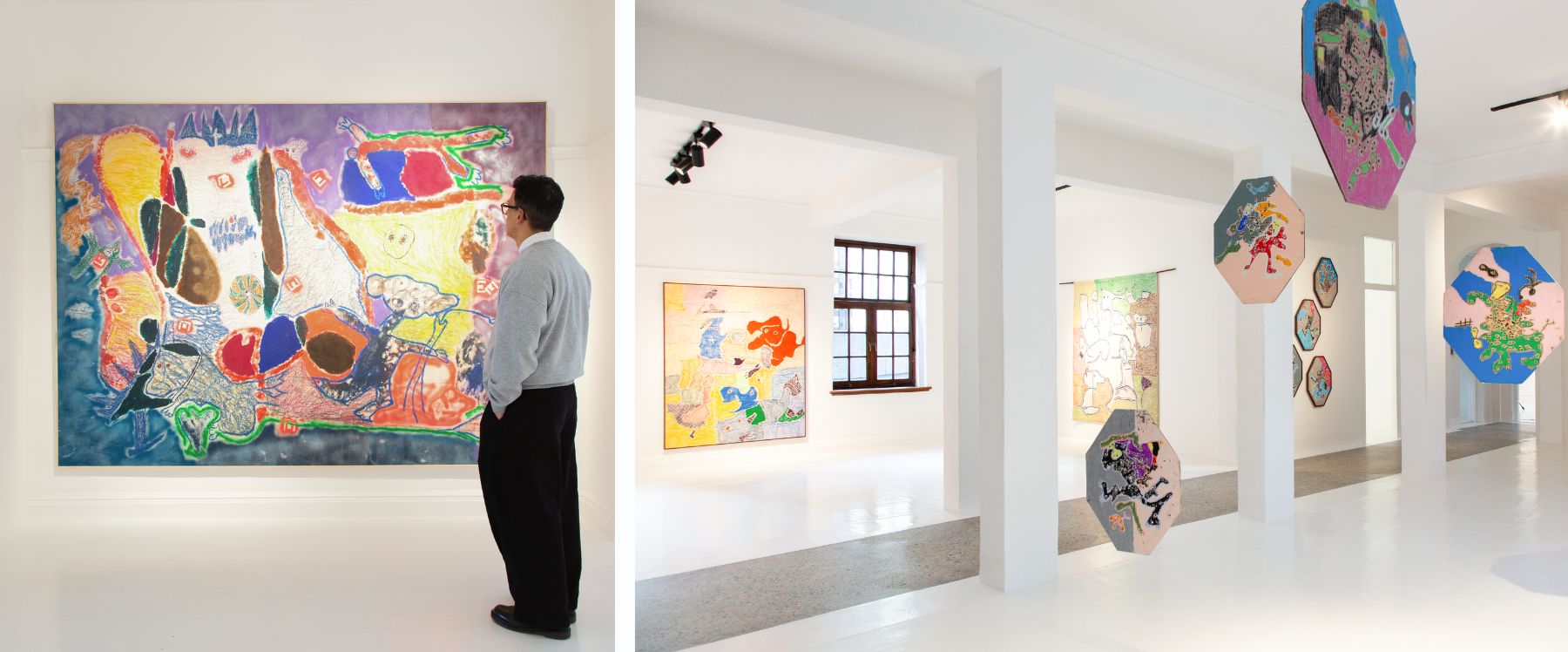
Lemkus Gallery presents Theme Park, a solo exhibition by Oupa Sibeko featuring works produced in residence alongside previous works and remnants of past performances. Sibeko is an esteemed performance artist from Johannesburg, whose career has been shaped by prestigious local and international residencies/fellowships (Reykjavík, Iceland; Windhoek, Namibia; Leipzig, Germany; Stuttgart, Germany; Johannesburg, South Africa; Cape Town, South Africa). The current post-residency exhibition marks Sibeko’s debut solo presentation in the city of Cape Town and signals his desire to establish himself within the local arts ecosystem.
A consistent feature of Sibeko’s work is his commitment to the grammar of play in cultural production— a silver thread that connects every project he has undertaken. While some may ascribe a general passivity to the process of play or may doubt its generative capacity as a vehicle for critical thought, Oupa Sibeko’s work succinctly exposes the structures that regulate daily life, latent behavioral conventions, and residues of colonial violence in the public domain. Despite not claiming themselves as direct forms of critique, Sibeko’s artistic expositions have great social, political, and ontological implications. Take for instance his long-standing engagement with ‘surface play’ as a way of marking the relation between the Black body and space, revealing his ability to conceptualize and resolve these encounters with great wit and spontaneity.
For Sibeko, performance is also a pledge, a way to fulfil his vow to continue to play throughout life1. As a mandate for making maintained through all his works, play inevitably takes different forms and points of focus. At times the performance is purely momentary. Sometimes there are traces. Sometimes the traces are the work. Following this logic, he proceeds to play on usual and unusual surfaces, employing frottage on canvas to lift the texture of street pavers in Zonnebloem (previously District Six), using targets collected from a shooting range at Vredehoek Quarry as the basis for abstract drawings on cardboard, or testing coarse sandpaper as the substrate for pastel illustrations. These material and site-based interventions trace a psychogeography of the city.
×
Lemkus Gallery Presents Theme Park by Oupa Sibeko
Lemkus Gallery presents Theme Park, a solo exhibition by Oupa Sibeko featuring works produced in residence alongside previous works and remnants of past performances. Sibeko is an esteemed performance artist from Johannesburg, whose career has been shaped by prestigious local and international residencies/fellowships (Reykjavík, Iceland; Windhoek, Namibia; Leipzig, Germany; Stuttgart, Germany; Johannesburg, South Africa; Cape Town, South Africa). The current post-residency exhibition marks Sibeko’s debut solo presentation in the city of Cape Town and signals his desire to establish himself within the local arts ecosystem.
A consistent feature of Sibeko’s work is his commitment to the grammar of play in cultural production— a silver thread that connects every project he has undertaken. While some may ascribe a general passivity to the process of play or may doubt its generative capacity as a vehicle for critical thought, Oupa Sibeko’s work succinctly exposes the structures that regulate daily life, latent behavioral conventions, and residues of colonial violence in the public domain. Despite not claiming themselves as direct forms of critique, Sibeko’s artistic expositions have great social, political, and ontological implications. Take for instance his long-standing engagement with ‘surface play’ as a way of marking the relation between the Black body and space, revealing his ability to conceptualize and resolve these encounters with great wit and spontaneity.
For Sibeko, performance is also a pledge, a way to fulfil his vow to continue to play throughout life1. As a mandate for making maintained through all his works, play inevitably takes different forms and points of focus. At times the performance is purely momentary. Sometimes there are traces. Sometimes the traces are the work. Following this logic, he proceeds to play on usual and unusual surfaces, employing frottage on canvas to lift the texture of street pavers in Zonnebloem (previously District Six), using targets collected from a shooting range at Vredehoek Quarry as the basis for abstract drawings on cardboard, or testing coarse sandpaper as the substrate for pastel illustrations. These material and site-based interventions trace a psychogeography of the city.