




Studio Life: Hope? on special offer
Store Review (0)PRESENTED BY : Warren Editions
| Frame | None |
|---|---|
| Medium | Photogravure & Drypoint on Gampi Chine Collé & Hahnemühle Natural White 300 g/m² |
| Location | Cape Town, South Africa |
| Height | 44.00 cm |
| Width | 54.00 cm |
| Artwork Height | 24 |
| Artwork Width | 42 |
| Artist | William Kentridge |
| Year | 2022 |
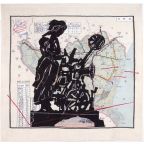
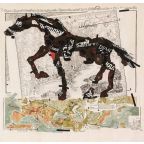
Studio Life series by William Kentridge comprises twelve photogravures. Published by David Krut Projects, with project management by Jillian Ross Print, and master printer Zhané Warren making the twelve plates. Kim-Lee Loggenberg from David Krut Workshop printed the twelve editions. The photogravure available through Warren Editions is Printer’s Proof III/IV. Photogravure, also known as heliogravure and recently referred to as copperplate photogravure, is both an intaglio and photomechanical technique. The technique combines the details of photography with densely pigmented etching inks. Using pigmented inks and acid-free pulp paper makes photogravure the most archival print technique. For photogravure, a continuous tone positive is exposed to light-sensitive pigmented gelatin tissue, which afterwards is bonded to a rosin-coated copper plate. The very fine rosin grains are the material matter of aquatint, which is key to the tone-based photogravure technique. Aquatint is a way of making tones. Despite the “aqua” in its title, the aquatint process does not involve water. It was invented in the mid-eighteenth century to simulate watercolour drawings. With aquatint, one can capture a complete tonal range from a hint of a tone to mid-tones to shadows and darks. Aquatints can be airy like those in the etchings of Paula Rego to velvety like those in the etchings of Pablo Picasso.
In photogravure, after the gelatin is developed, the copperplate, with the image containing gelatin, is etched in baths of ferric chloride of different strengths. The etching commences with the extreme darks, moving through the tones to the lightest tone, pulling the etched copperplate from the ferric chloride once the bite reaches the spectral highlights. Therefore, the technique achieves a full range of tones and attests to the high quality of the original print. Kentridge added drypoint onto the photogravure plate. Drypoint, essentially a form of engraving, is a sensitive and immediate (direct / additive) intaglio technique. It is not etching because no acid is used to create the incisions in the metal plate; instead, a sharp tool and the artist’s hand are used. Due to the directness of the needle on the plate surface, drypoint allows for expressive flowing lines while simultaneously accommodating jagged and ‘irritated’ lines. Paper is as elemental in printing as the ink colour, tone and technique you employ. In chine collé, a thin sheet of paper is printed while simultaneously being pasted onto a sturdier sheet of paper – all this happening as the thin paper, inked metal plate, and base sheet are being rolled through a roller press.
 Download PDF